
Blog · Future of work
The future of work is Claude assisted by a human.
For a while the phrase was “a human assisted by AI”. Watch a modern engineering session honestly and the description no longer fits. The model does the work; the human directs it, verifies it and answers for it. That flip changes more than tooling, and I think it is good news.
The quiet flip#
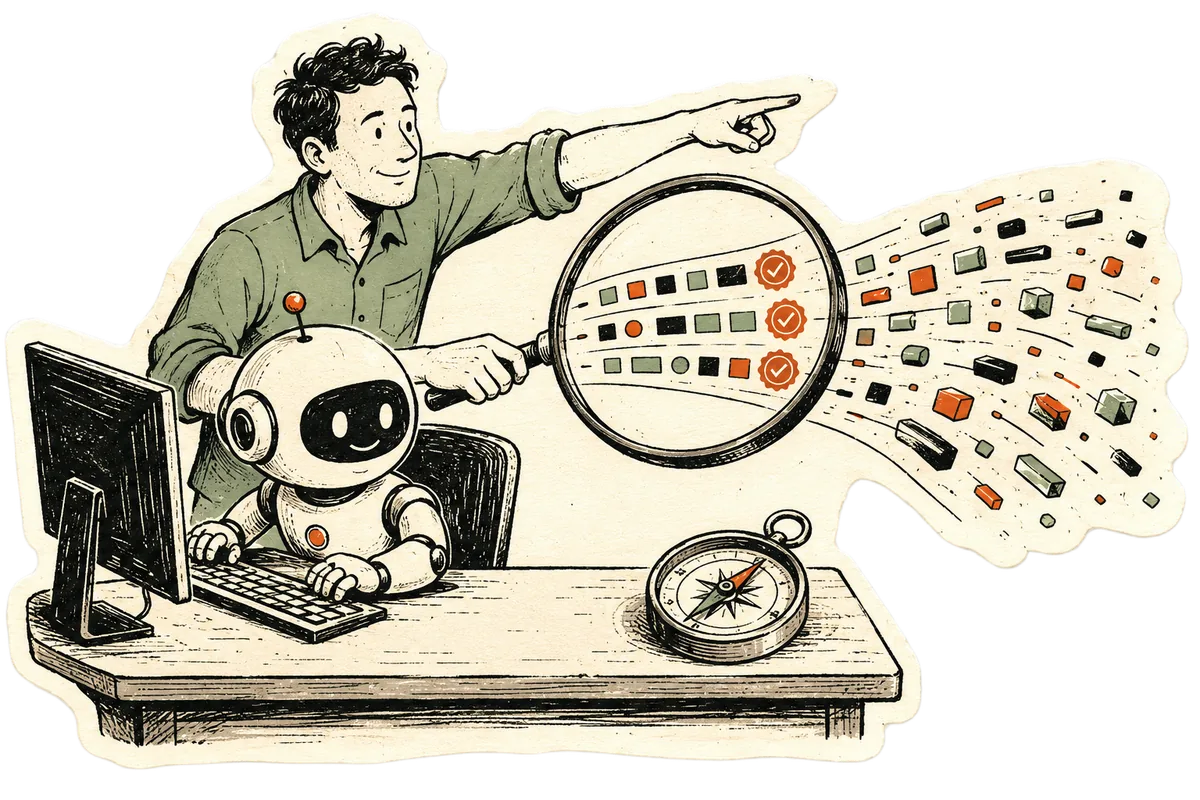
Nobody announced it. One month the assistant completed lines; a few months later it completed functions; then one day you realize the session has inverted. You describe an outcome, Claude works across the codebase, and your keyboard time is spent reading, questioning and deciding. The human is no longer the one being assisted. The human is the assistance: the judgment wrapped around the machine that produces.
Resisting the observation out of pride seems pointless to me. The interesting question is what the human role becomes when production is no longer the bottleneck.
What the model now carries#
In our daily reality, Claude carries the long reading, the first draft of almost everything, the mechanical layers of a migration, the tests nobody enjoyed writing, the first pass of review and the documentation that used to be a guilty backlog. It carries breadth: it does not care whether the file is Java, SQL, YAML or a ten-year-old shell script.
What it produces is not always right. It is, however, always available, and available changes behavior: you explore three designs instead of defending the only one you had time to build.
What stays human#
Four things, and I do not see them moving. Intent: deciding what is worth building at all, which no amount of capability supplies. Context: knowing what the organization actually needs, including the parts written nowhere. Taste: recognizing the difference between code that works and code the team can live with for five years. Accountability: a change that reaches production has a human name on it, and that name is not Claude.
Claude carries
- Long reading and breadth
- First drafts and repetition
- Mechanical implementation
The human holds
- Intent and context
- Taste and verification
- Final accountability
Claude can produce nearly anything except the reason to produce it. Intent, context, taste and accountability are the job now.
Verification is the new craft#
When production is cheap, judgment is expensive. The engineer’s core skill shifts from writing code to specifying it and verifying it: framing the problem so the model cannot misunderstand it, designing the invariants that must hold, and reading a large diff quickly without being lulled by its confidence. A fluent wrong answer is the failure mode of this era, and the antidote is a verification culture, not blind trust in either direction.
None of this is actually new. It is what a good tech lead has always done with a team: give direction, set constraints, review honestly, take responsibility. The flip generalizes the tech lead’s posture to every engineer.
What it means for teams and juniors#
For teams, the scarce resource stops being hands and becomes judgment, which is why I spend my energy on ownership, context and review discipline rather than on output. A team that cannot verify will not be saved by a model that can produce.
For juniors, I am more optimistic than the pessimists. Yes, the reps that used to build intuition, writing boilerplate, tracing bugs by hand, are disappearing. But juniors now watch expert-level work happen in front of them all day, can interrogate it endlessly, and can own a real system earlier than any previous generation. The risk is skipping the struggle entirely; the fix is deliberate: small systems owned end to end, with a human mentor and honest reviews. Judgment still comes from consequences.
Where the flip stops, for now#
I want to stay honest about the boundary. Ambiguous product intent, organizational tension, incidents whose context lives in people’s heads, decisions that trade one stakeholder’s pain against another’s: this is where the human is not assisting anyone, the human is simply doing the work. And in regulated environments, accountability is structural: someone must be answerable, and it cannot be a model.
So no, I do not think engineers are becoming spectators. Direction, verification and responsibility were always the senior part of the job. The tools finally caught up with that truth, and they are pushing everyone toward it. A future where the machine produces and the human is fully occupied with judgment does not sound like a demotion to me. It sounds like the job, distilled.